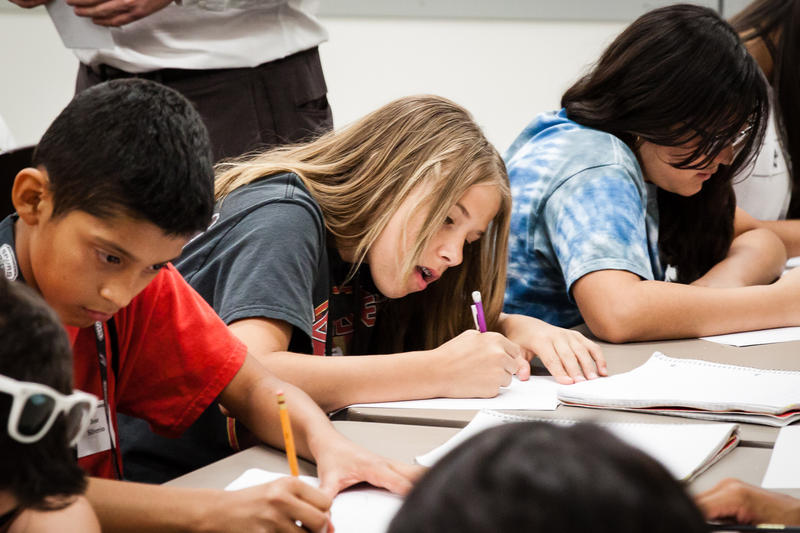
Belgium’s school system ranks among the most unequal in the OECD. Children from low-income families are three to four times more likely to be directed toward specialized education, a path that frequently closes doors to professional training and full civic participation. Behind that statistic are real stories: a mother told by a teacher that her daughter’s “place is not here.” A young woman who describes herself as being treated “like I’m disabled.” Teachers who feel helpless, asked to include and adapt without the resources or training to do so.
These stories and statistics have coexisted for decades. What has been missing is a process that takes all of them seriously, at the same time, on equal footing.
Croiser les Savoirs pour une École plus Juste (Crossing Knowledge for a Fairer School) is a participatory research project co-led by Smarter Together and ATD Quart Monde. Its founding conviction is that the people most affected by educational inequality are not just subjects of research. They are experts in their own right, and their knowledge is indispensable to solving the problem.
The project brings together four peer groups: parents living in poverty, young adults who experienced exclusionary school trajectories, education professionals, and academic researchers. Each group first works separately, developing and articulating its own analysis. Then, in a carefully facilitated process, the groups cross their perspectives with one another. A parent’s account of shame and misunderstanding at the school gate sits alongside a teacher’s description of being overwhelmed, and a researcher’s reading of the data. None of these perspectives is treated as more valid than the others. All are necessary to understand the full picture.
This is the Croisement des Savoirs methodology, developed by ATD Quart Monde over more than 20 years and tested in over a hundred experiments worldwide. It does not just consult people with lived experience. It recognises them as co-researchers, with an equal stake in shaping the questions asked and the conclusions drawn.
The project runs over eight working days between September 2026 and January 2027, including three residential weekends at the Kaleo gîte in Hastière and two plenary days in Brussels. Sessions move through four stages: building mutual understanding across groups, co-formulating the research question, crossing knowledge between all four groups, and collectively drafting a report with concrete recommendations for policymakers in the Fédération Wallonie-Bruxelles.
To make participation genuinely accessible, travel costs are covered, meals are provided on a pay-what-you-can basis, and childcare is available on site. These are not minor logistics. They are a statement about who this process is actually for.
The project has three concrete goals: a research contribution on school inequalities in Belgium developed with active academic involvement; policy recommendations on inclusion in mainstream schooling and orientation toward specialized education; and a replicable model of participatory research that others can learn and carry forward.
The broader ambition is a school system that enables every child to succeed, regardless of their background.
This project is a direct expression of Smarter Together’s mission: designing collaborative processes that allow diverse groups, including those rarely heard in formal settings, to tackle complex challenges together and produce better, more legitimate outcomes. Smarter Together co-leads the project structure and facilitates key sessions alongside ATD Quart Monde.
Interested in learning more or getting involved? Contact Victor Lauret at victor@dreamocracy.eu
open access handbook for change makers
Lorem ipsum dolor sit amet, consectetur adipiscing elit. Ut elit tellus, luctus nec ullamcorper mattis, pulvinar dapibus leo.
Every 2 weeks, you’ll get: